
Value of Vintage – Norma Kamali, Iris Apfel & Stephanie Solomon
Vintage Intermezzo, with Norma Kamali, Iris Apfel & Stephanie Solomon
Intermezzo, a fashion and accessory wholesale trade show held twice a year at the Javitz Center in New York City, did something revolutionary this month. In addition to the regular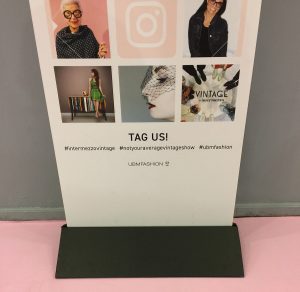 wholesale booths, the show included a section called Vintage Intermezzo with vintage sellers offering one-of-a-kind clothing and accessories to attendees for their retail shops. Is this a a sign of the times? Are consumers finally tiring of the same thing in every store? Madge certainly hopes so. The highlight of Vintage@Intermezzo was The Value of Vintage, a conversation with Norma Kamali, Iris Apfel, and Stephanie Solomon moderated by Lauren Parker, Editor-in-Chief, Accessories Magazine. Madge was lucky enough to attend.
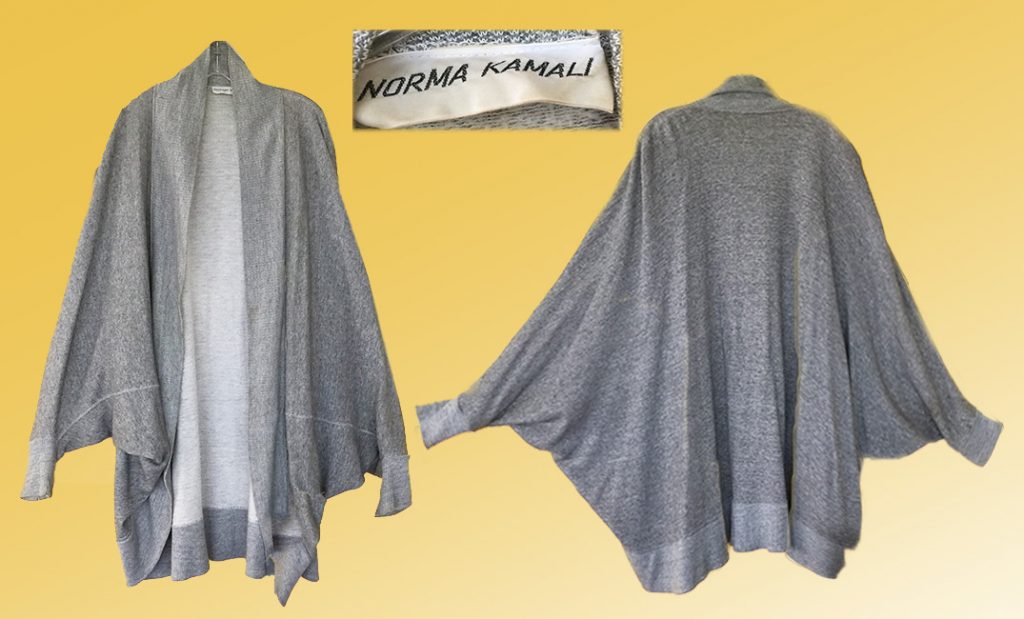
Norma Kamali has owned her own fashion design house since the late sixties and has been a major innovator in women’s fashion creating iconic pieces like the sleeping bag coat and accessories like the first high heel sneakers. She was ath-leisure decades before the current fad and also created a jersey collection, flattering to all shapes and sizes of women, that is still sold in stores today. Madge has always loved her designs and still wears a coat made from sweatsuit material she purchased new in the late 1970s. Kamali is one of the few designers of either sex to still own her company and not be controlled by a large corporation. She continues to design innovative and flattering clothing and accessories. Among many accolades, she received the CFDA Lifetime Achievement Award in 2016. Kamali has provided costumes for nine Twyla Tharp productions and for the movie The Wiz. She even has a vintage collection for sale on her website.
Madge wants to be Iris when she grows up. At 96 (her birthday is this week), Iris Apfel is more of a style icon now than ever before. Having traveled the world several times as co-owner of Old World Textiles, who helped nine first ladies decorate the White House, she has the confidence to style her way. And boy, does she have the most heavenly costume jewelry collection on the planet. Even the Costume Institute at the Metropolitan Art Museum agreed with their 2005 show, Rara Avis: Selections from the Iris Apfel Collection. Apfel held the honor of being the only living person ever to have a retrospective at the Met until the Rei Kawakkubo show this year, and helped curate all of the classic Iris looks at the show. In the 2015 documentary Iris, by the late Albert Maysles, the Met curator admits that although her show was a last-minute fill-in, it took all of New York City by storm, turning her into an international fashion sensation, or as Iris puts it, “a geriatric starlet”. That 600-piece collection was donated to the Peabody Essex Museum in Salem, Massachusetts.
Stephanie Solomon is the VP Fashion Director at Lord & Taylor. Before that, she spent 29 years as the fashion director for Bloomingdale’s. Always the innovator, at Lord & Taylor, she launched the Birdcage shop within a shop, The Dress Address, New York’s largest dress destination, and even a vintage pop-up shop. Stephanie was inducted into Accessories Magazine Merchant Hall of Fame in 2016.
Here is part of their fascinating conversation on
The Value of Vintage at Vintage Intermezzo
I think vintage is an elegant name for old clothes – Iris Apfel
Lauren: First question, what is your favorite vintage piece, the story behind it, and how you wear it today?
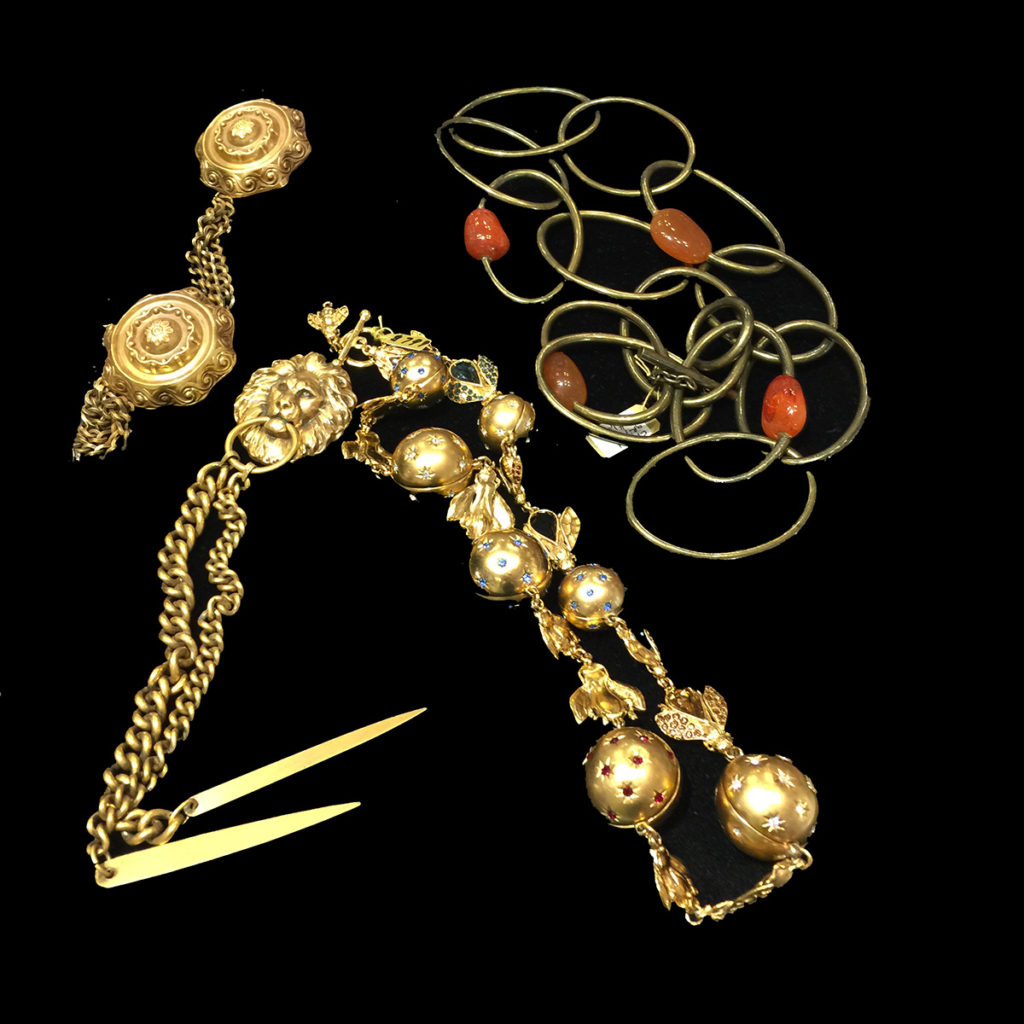
Stephanie: My favorite vintage piece is a bracelet I fell into while shopping in some crazy place in Milan. It’s a 1940s gold bracelet. I had no money, but I literally spent every cent that I had on this bracelet. I didn’t wear it, but I should have. Today, it’s still my most coveted piece. After that, it’s my aunt’s wedding ring that I still wear. I believe very strongly that vintage jewelry has energy and bestows good luck, especially on people you know and love.
Norma: I’m wearing them, my glasses. I found them probably forty years ago, and I’ve been making them in different materials ever since.
Lauren: Iris, you’re going to have to dig deep.
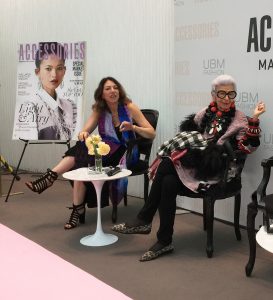 Iris: I have so much vintage I guess it’s all favorite. I can talk about this Michaele Vollbracht jacket I’m wearing. When I get up, you can see the back; it’s better than the front. But to me, I’ve never found a definition of vintage that suits me. Yesterday was a prime example. I went shopping [at this show], and I bought a number of things, from a Victorian coat that is divine up to a wonderful jacket by Comme des Garçons. When I asked the guy what collection it was from, he said 2016! I think vintage is an elegant name for old clothes. Maybe there has to be a new definition because I think there should be something special for one-of-a-kind or unusual pieces that are not run-of-the-mill. They can spice up any outfit. Age in itself doesn’t mean anything. I’m a prime example of that. It’s got to have some pizzazz. I think there needs to be a qualifier. It’s cuckoo now. Everything that was made a week ago is vintage. I’m serious. I buy a lot at markets, and I don’t believe anything anyone tells me anymore because there are so many good reproductions out there. Unless you are paying an absolute fortune, I wouldn’t worry about the provenance. Who cares? If it looks good and you can afford it, go for it.
Stephanie: Iris used a term that resonates very strongly right now, and it’s called one-of-a-kind. I just recently read a business analysis that said customers are now 60% more likely to look for one-of-a-kind items than they were one year ago. That in of itself is a trend.
The worst fashion faux paux is looking
in the mirror and seeing somebody else – Iris Apfel
Lauren: I think that’s true. What’s interesting about trends is when people wear trends, what is dictated for the season, they are getting that stamp of approval. It’s trend-approved, and you know what you’re wearing is okay. Vintage requires a lot more creativity. You need to go to the store, find something you like, and have the confidence to put it all together. Do you think that consumers just don’t have the confidence to put it together? How do you suggest they tiptoe into vintage if it’s something they’ve never done before?
Iris: I think people really have to get to know who they are to pull something off. Just because something is a trend doesn’t mean everyone can feel comfortable; it doesn’t look good on everyone. Trends are good for the manufacturer and the store, but not so good for people. I think the worst fashion faux pas is looking in the mirror and seeing somebody else. That’s what so many people do because so many current fashions look ghastly on them. If you are short and plump, you can’t wear the same things as someone tall and willowy. You need to know who you are physically, who you are mentally, how you are spiritually, and what you can carry off and feel comfortable with. If more people did that, they would look better.
Lauren: How did you get the confidence to mix and match the way you do??
Iris: I don’t have a clue I think it was in my DNA but I also had to work at it. God can give you certain givens, but you have to work at it. You can have the basis for a beautiful singing voice, but if you don’t cultivate it, it’s no good. You can desperately want to be a great singer, practice all day long, go to the best vocal coaches, and just croak. It’s a matter of common sense.
Lauren: To the panel, do you mix eras when you wear vintage, or do you stick to one era? And if you stick to one era, how do you make it look like you’re not wearing a costume?
Stephanie: If you aren’t looking like yourself, you are wearing a costume. That’s a taboo in terms of the way I feel about style. Mixing is probably the only way to go. I hate to use the word spiritual because that’s a little serious for fashion, but there’s something about seeing vintage and relating to it. When you see it displayed in a case or the window, you feel something, you don’t know why, you may even feel the energy within it, and say I must have it. So there is some karma involved. When I buy vintage, I always wonder who wore this before me, and then I fantasize that it was someone interesting like Norma or Iris. Vintage has a history that new clothes don’t have. Vintage makes me imagine and be creative. I mix up everything and just put on my favorite things. I wholeheartedly agree with Iris that you need to know your body, know your style, and know what will be attractive to the world and to yourself.
We live in a time where everybody is looking forward
or looking down into their devices
Looking backwards at history
takes an awful lot of interest- Norma Kamali
Lauren: Norma, I think I read on your website that you are very influenced by the forties?
Norma: Just a little background, when I was 14 – 16 years old, in the early sixties. I had about $1.50, which was a lot then, and I realized I could find one-of-a-kind type things in vintage stores that were just then becoming underground popular. I then could go to S. Kleins, nobody here knows it, and buy a $2 dress, take off all the trimmings, add the vintage to it, and then I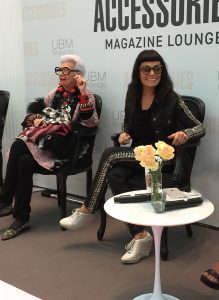 would have something that was me. It wasn’t until the late sixties, when I was spending a lot of time in London, that Antiquarius was really a focal point for me. By the seventies, everyone dressed just the way they wanted and would kill themselves if they looked like anybody else. Nobody had a stylist. If you wanted to wear a red sock and a yellow sock, you did it, and your expression of yourself was the way you put yourself together. That creativity was part of who you were. You didn’t have to say your name. The seventies allowed everyone to be fully expressive and as creative as possible with clothing because vintage was so readily available then. It was so easy to get, I used to buy big bags full of vintage from the twenties through the fifties and sell it in my store.
From the seventies to now, vintage has gone through this kind of movement. So anybody who has an interest in vintage spiritually still has that expressive soul of someone from the seventies. And I say God bless you because we really, really need more expressive individuals who look amazing. However, we live in a time when everyone is looking forward or down at their devices. Looking backwards at history takes an awful lot of interest, and it may not be a characteristic of a millennial to want to do that. So again, how strong your soul is for vintage really is the dominant force in whether or not you wear all vintage, a little bit of vintage, your grandma’s ring, whatever it is. For vintage to have a life today, I think we need to ask: Will it be okay for people not to dress like everyone else on Instagram? Where are all the expressive, gorgeous individualists with style on Instagram wearing vintage? Where are you? There aren’t enough of you. There are a lot of pretty girls in pretty dresses that all look the same, but I’m putting a call out. Where are all of you on Instagram who have style and who know how to take vintage and make it look fabulous? So do it. So, I’m looking forward to using Instagram, taking vintage, mixing it, and becoming modern today. This expression must exist.
Find yourself. There needs to be a counter balance to what social media
stands for – a ploy to get you buy someone else’s life – Stephanie Solomon
Lauren: Let’s hope everyone takes Norma’s advice and the hashtag #NormaSays.
Iris: What do you think happened after the seventies that made everyone so uptight about getting dressed?
Norma: I think a lot happened. Prior to women entering the workplace, there was this transition from Mad Men times, when we were all wearing girdles, cone bras, and stockings with garter belts, to not wearing any underwear at all. That was my favorite. I think women going to work changed it up. Looking expressive or individual was not really what we were able to do in the workplace. There was a need at the time to wear a power suit and to look like men, and I think as the generations go by, more and more girls, especially, want to look like each other, as we see on Instagram. There are lots of pretty girls in the same poses, wearing the same clothes, and they are happy there.
Stephanie: Well, that’s the whole purpose of Instagram. I want to be you. I want your life. I’m going to buy your earrings. That in itself is anti-creative. We need to celebrate those women who tell you, #NormaSays, be yourself. Don’t copy my earrings, my handbag, because you know what? It might not look the same on you. Find yourself. There needs to be a counterbalance to the reason social media stands for – a ploy to get you to buy My life.
In the seventies, I was also around; you didn’t have that. We had what we read about, what music we were listening to, and lots of other influences, which I won’t mention. So we were strongly encouraged to be as creative as possible. We were also rebelling against our parents. God forbid we dress like our parents. That’s why they called it the rebellious revolution. You would not wear what your mom wore. You wore exactly the opposite. The miniskirt was the epitome of rebellion. I remember going to school in a miniskirt, getting kicked out, and being a hero. When I went home, my mother punished me. I swear I was grounded for a whole year.
Norma: I think the individual, no matter what era, still exists, and being an individual means you have courage, your self-esteem is pretty intact, and you have a sense of self that is key to who you are. Women have it sometimes, and other times they don’t. We’re hormonal human beings who sometimes feel good about ourselves and other times we don’t. The idea of expressing yourself and creative beauty is something anyone can do. That kind of individual can survive through different eras and make a name for himself or herself.
For vintage to have a life today I think we need to say
it’s okay for people to not dress like every other person – Norma Kamali
It was so exciting to be at Vintage Intermezzo and hear these fashion icons talk about the value of vintage. Madge was so grateful to know these powerful women feel exactly the way she does about vintage. This was the very reason MadgesHatbox Vintage was created to help women and men find their personal style by adding vintage to their lives every day. That’s it for part one. Check back next week for part two of this fascinating conversation – where fashion retailing is headed.
What’s your favorite piece of vintage? Please post in comments.
Check out Madge’s earlier post on Iris