Norma Kamali, Iris Apfel & Stephanie Solomon
Dish About Vintage
Norma Kamali, Iris Aprel & Stephanie Solomon Dish About Vintage
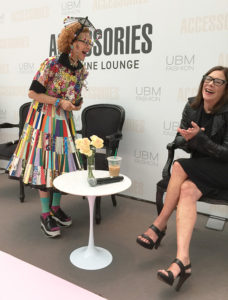
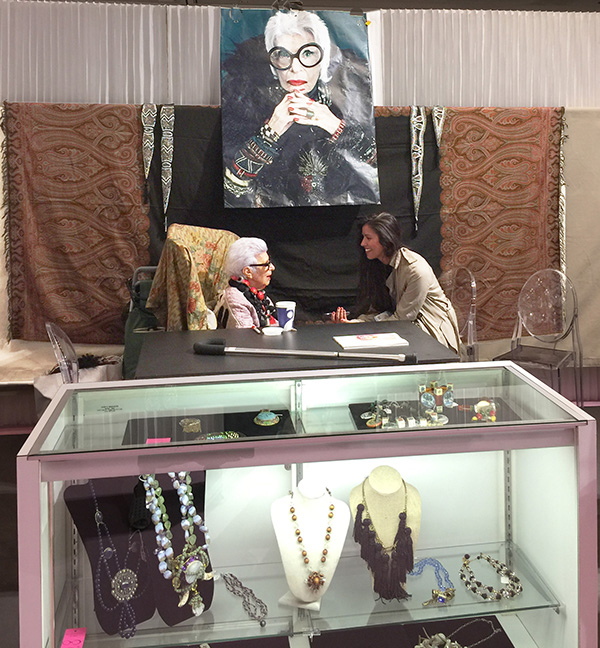
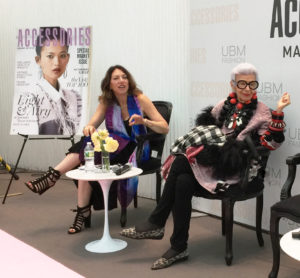
This summer’s Intermezzo wholesale trade show in New York City introduced the revolutionary idea of giving fashion retailers access to top vintage sellers offering one-of-a-kind clothing and accessories for their shops. The highlight of Vintage@Intermezzo was a conversation among Norma Kamali, Iris Apfel, and Stephanie Solomon, moderated by Lauren Parker, Editor-in-Chief of Accessories Magazine. Madge was lucky enough to attend.
In part two of The Value of Vintage, the panelists discuss what part vintage will play in the future of fashion design and retail. Part one of this discussion is available here.
Here is part 2 of their fascinating conversation on
The Value of Vintage
I don’t stick to one period because there was good and bad pieces always. I just buy what I like and I don’t’ care when it was made.
– Iris Apfel
Lauren: I want to talk a little bit about retail. Stephanie, tell us how Lord & Taylor used vintage in the Dress Address and the pop-up with Decades by Cameron Silver?
Stephanie: First of all, it was a total unmitigated success. I was shocked. You don’t often see true vintage ready-to-wear in stores. Jewelry and accessories are a little bit more common to find. I would go to the pop-up every few days and see the stock diminish. People just gravitated toward the pieces. The prices were normal, not so low as to be giveaways. So there is an undercurrent, a movement starting to happen in vintage, and if you read the numbers on some of the vintage websites, they are pretty impressive. I do believe, Norma, that Millennials are starting to appreciate the value of vintage, whatever that means. To some, that could mean a minute old. My point is, it resonated very strongly with Lord & Taylor. We’ve had a vintage jewelry case since 2005, and it does very well. It’s something that retailers should investigate a little bit more closely because, as I said, Gen Y and Millennials are starting to notice.
Lauren: In the Galleria Mall in Dallas, there’s a current exhibit called Night Fever, Fashions from Funk to Disco, with 75 garments and accessories. This exhibit shows that malls are trying to create more experiences and get people excited. Can that segue into a boutique doing a pop-up, if they don’t feel comfortable doing full-on vintage?
Stephanie: Of course, the problem for retailers is you can’t reorder vintage. Once it’s gone, it’s gone. You have to replenish and be current. But there are also trends in vintage. We all know that Gucci is the bomb right now. So Gucci vintage is also happening in a significant way, trickling down from the current runways to the vintage stores.
Lauren: Iris, is there one particular era that is your favorite when you shop for vintage, or when you look back fondly on all the stuff you have collected over the years?
Iris: I don’t stick to one period because there were always good and bad pieces. I buy what I like, and I don’t care when it was made.
Lauren: What’s selling over at your booth at Vintage @ Intermezzo? Are there certain items that people are gravitating towards?
Iris: Well right now we have sold a lot of statement necklaces. People are beginning to like big, bold jewelry, not just very discreet, itsy, bitsy things. I think if you are going to wear jewelry, it should make a statement. I’m a firm believer in accessories of all kinds. Of all the accessories going, I think jewelry is the most transformative. You can take the same little black dress and, by changing the jewelry, go from the office in the morning to an elegant lunch, then to a cocktail party. Just by changing your shoes, bracelets and earrings go on to a gala occasion. I did that for a couple of shows in museums, and people couldn’t believe it.
I was born during the depression years, and we had to make do and learn how to do a lot of things. As I have always said, my mother worshipped at the altar of accessories. She had a very willing acolyte, and she taught me a lot. She always said that if you get a few good, basic architectural pieces, you can change your look, what you want to say, and how people think of you with your accessories. You really can make dozens and dozens of outfits out of very little, and I live that way and firmly believe in it. I think it helps people be a little more creative, too, because even if you buy the same clothing and want to look like everybody else. You can still change it just a little bit by your own choice of unusual jewelry.
Lauren: You are certainly embodying that spirit.
Iris: Well, I practice what I preach.
If you love something it will last forever – Norma Kamali
Lauren: Let’s talk about pop culture a little bit. Is there anything you guys are watching on TV or seeing on the street? Mad Men is over, and it certainly influenced vintage. Is there anything now that you look to for ideas or inspiration?
Norma: I think this is such a fantastically disruptive time that looking for inspiration in places or through vintage is not what we should be thinking about right now. One of the things, talking about eras and what’s culturally happening at different times, I originally made the sleeping bag coat in the early ’70s, and I still sell it. I did sweats in the late 70s, and I still sell sweats. I did a jersey collection of eight dresses and I was wearing a lot of vintage at the time in the 70s and I said to myself I want these dresses to be the vintage of the future. Actually, the top I’m wearing today is a short version of one of the dresses, and this can be worn eight to fifteen different ways, and I still sell it. So sometimes vintage is timeless. In fact, outstanding vintage is always timeless, and you are seeing an example of that right here with Iris. Some things always look good, and they are decades old. The sleeping bag coat was recently on the cover of a magazine, and I also just did it for Lady Gaga’s show that’s coming to New York. This means vintage, that is great for you, is timeless, and it’s an investment you make for yourself forever. I think that’s an important thing to think about. If you love somethin,g it will last forever.
Stephanie: May I answer that as well? I’ve been thinking about this also in preparation for this panel. When I look at the quality of the vintage pieces in my wardrobe, I then look at the quality of fast fashion, which is nonexistent. If you think of the appreciation of quality, vintage is so valuable, and it’s really beginning to emerge when you start to recognize the value of workmanship, craftsmanship, and creativity. All of the things that make good fashion, classic fashion, fashion that lasts in your wardrobe. Vintage is a counter-argument to fast fashion.
Lauren: I was talking with a woman in the audience who is an e-tailer. She sells vintage and promotes it as sustainable. I think when you talk to people, particularly the younger generation, they are more concerned with the environment, so people might not want to buy throwaway fashion. They will buy something pre-owned. It’s already been created thus won’t do any damage to the environment. I think retailers that want to get into vintage can really use this as a selling point.
Norma: Recyclable fashion
Stephanie: So it doesn’t end up in a heap on the floor. There’s so much waste, particularly in relation to fast fashion.
Vintage is a counter-argument to fast fashion – Stephanie Solomon
Lauren: So, Iris, I watched your documentary the other day, and I took notes on some of your best quotes. Did everyone see her documentary?
Iris: It was just nominated for an Emmy.
Lauren: Iris has some great quotes that kind of sum up everything. One is “More is more and less is a bore”.
Iris: Well, it is for me, but I am not anti-minimalist. Many, many women look divine when they dress minimally. I look freaky. They would look just as dreadful wearing all the junk I lug around. As I said before, you have to know yourself.
Lauren: Iris also said, “I have no rules because I’d just be breaking them all the time. So I think that goes with her credo of mixing and matching and doing what you want.
Iris: Exactly. I think you have to do what you want within reason. Because fashion trends go this way, like with no underwear, then they go that way. You need to think about the poor underwear manufacturers. Seriously, I think there has to be a balance.
Lauren: My favorite Iris quote is on thinking outside the box. “If you’re just going to do the same damn thing all of the time, you might as well jump into the box yourself.” Iris, do you think you’d have this sense of style if you weren’t a vintage collector? Do you think you could put together such an eclectic collection with only items sold in retail stores?
Iris: Oh no, that’s why I think retailing is in the doldrums. You walk from one store to another, and it’s déjà vu. Everybody has the same damn stuff. It may be a different price point, but if you go down any given street, you will see the same blazer, same style, same color, in seven different qualities and price ranges; but it’s the same thing. There’s just no inspiration. No difference. I don’t buy labels, and I don’t buy names. If what I do equals vintage, then so be it. It’s like when you cook, you need some spice, otherwise everything would taste blah. You may be pleased looking blah, but if you don’t, you have to do something about it, and what’s called vintage today seems to be the easiest go-to.
So the irony of the Millennials and the disruption they have caused is really another door opening to a new kind of creativity. – Norma Kamali
FINAL THOUGHTS from the Q & A
On Trends:
Iris: Even if you want to be untrendy, everything ends up being a trend anyway. There are very few people who have the courage of their convictions. I do a lot of work with young people, and sometimes I bang my head against the wall. I find they give a lot of lip service to individuality, but then they go off and do the same thing as everybody else. As long as social technology keeps rearing its ugly head, we are going to be in trouble. You all are considerably younger than I am, so I saw the 60s and 70s from another vantage point. I don’t think there was as much creativity as people say there was. There were a few violently creative people, but then the masses copied them.
I don’t think they were original in the way they dressed at all. Maybe they felt freer and they were doing something that hadn’t been done before. But I don’t think they were that creative. I could be wrong. It all boils down to if something is good everyone tries to have it or copy it or have some connection with it. There are lots of good things I see that are wonderful but are not for me. I don’t think people give themselves enough time or credit to figure it out for themselves. That’s why they buy labels, and they’ll buy a coat for more money than what Norma’s coat is selling for, because if it says Chanel or something else, it’s terrific. I don’t understand that, and I never did. I find, sadly enough to report, that in all my observations, that is what’s going on. I don’t see Millennials being creative at all. They’re button pressers.
On Being a Young Designer Today:
Norma: The best way to be a successful designer is just to be yourself, to tell your story through your clothes, and to be authentic all the time. You don’t need to copy anything or be influenced by another designer. But if you are influenced by vintage because you love it, absolutely do it. I used to get vintage blankets and make coats out of them. There are a lot of vintage pieces that are disintegrating, and you can get them really cheap. Cut them up, protecting the areas that are still in good shape, and mix them up with modern fabrics. Just don’t be anybody else. Don’t make clothes that look like anybody else’s.
Iris: Let’s face it, there aren’t too many real designers today, and the few that are don’t get the credit they deserve. A lot of designers today are media freaks with little talent; they’re in, and they’re out. It seems to me that if you are a real designer, you have to know how to conceive of something, sketch it, cut it, drape it, and sew it. These people seem to design by committee.
Norma: Iris is so incredibly unique in her honesty and how she tells a story. The industry has indeed changed tremendously, and I think a lot of it has to do with technology. I’m a mixed-up person because I have been around a long time, but there’s also a part of me that thinks like Millennials. Kids are not trained in pattern-making or in everything else Iris mentioned. The training for that, and the desire to know it, are no longer required because of how clothes are produced and designed. One of the things I’ve been thinking about is if all of the draping and pattern-making skills aren’t used anymore, then does that mean that the sewing machine is no longer going to exist? So what happens then? I have created a new collection, which I haven’t sold yet, that is made entirely without a sewing machine, without a needle or thread.
The beauty of it is that I still feel it’s creative and I still feel it’s expressive but it’s creativity in a modern way. It looks like there will be a time where there will be no Millennials using sewing machines in any country. Because all of them will be communicating this way, (Holds up her phone) and they will say why am I sitting at this sewing machine? I want to be taking a selfie at McDonalds instead. So the irony of the Millennials and the disruption they have caused is really another door opening to a new kind of creativity. I had to challenge myself to see how creative I could be if I didn’t use a sewing machine. I didn’t use the tools that are part of my DNA. You’ve taken away pattern-making, draping, sewing, and sketching; you’ve taken away my identity. So, in the quest for never losing that, I tried another way. It was very exciting and very fulfilling. So I think there will be an original design even if the mechanics change. But you are right: the desire for people to have the skill set to do things the way they were isn’t there anymore, and the training isn’t either.
On Craftsmanship: – Is it disappearing?
Stephanie: This is the question of the century. Norma is thinking the way we all are – well, if it is going to disappear, that appreciation of craftsmanship, what happens to creativity? But creativity doesn’t go away; it gets supplanted by other ways to express it. But, in my heart, I hope it will never, ever die, that type of craftsmanship, that hand to fabric, that beadwork, and all of those petit mains that put together extraordinary pieces of clothing. Amazing couture designers still rely on those little hands. To see that disappear is very scary to me. But that’s okay; I will be in heaven looking down to see what happens.
Norma: I have something to add to this. There’s an excellent movement for women helping women that I am involved in. There are women around the globe who, with a bit of training, can be empowered to support their families and educate their kids. Sometimes it’s weaving or embroidery. It’s doing things by hand. Craftsmanship. There is an exceptional value in doing things by hand rather than mechanically. We are not only giving women an opportunity to stand on their own feet and be independent and strong; we are also continuing to appreciate beautiful handwork.
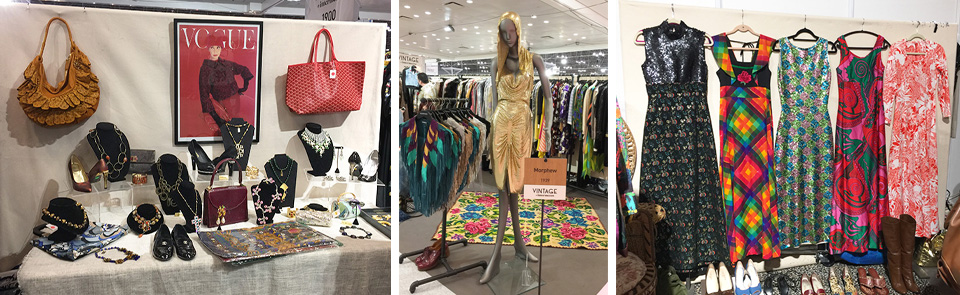
Wow, what an amazing session. Fashion design is heading into unknown territory but whatever happens, vintage will be right in the middle of it.